
Militancy and the Future of FATA’s Youth
For more than two decades, the former Federally Administered Tribal Areas of Pakistan have faced deep unrest. Militancy and military operations have changed daily life across the region. Schools, colleges, health centers, and local businesses have all suffered.
Among these losses, the damage to education stands out the most. When schools are destroyed or forced to close, young people lose more than classrooms. They lose hope, direction, and opportunity.
Education Under Attack
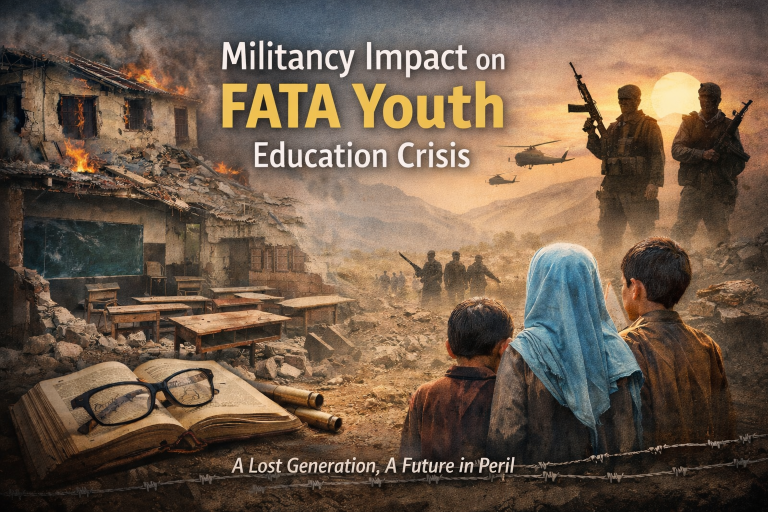
Armed groups often target schools because education builds awareness and independence. When young people are educated, they are harder to control. In FATA, hundreds of schools were attacked between 2007 and 2012.
Many buildings were blown up, burned, or left unsafe for use. Both boys’ and girls’ schools were targeted, which limited access to learning for entire communities.
Over time, the nature of attacks changed. Instead of targeting empty buildings, militants began attacking school buses and kidnapping students and teachers. These incidents spread fear among families.
Parents became hesitant to send their children to school, even when schools reopened. In some areas, schools were taken over and used as hideouts or storage sites for weapons. This further reduced safe learning spaces.

Displacement and Lost Academic Years
Military operations against militant groups led to large numbers of internally displaced families. When families leave their homes during the school year, children often cannot enroll in new schools immediately.
Many lose an entire academic year. When they return, they may have to repeat a class. This setback discourages students, and some drop out permanently.
Closed and damaged institutions remain another major challenge. Even after security improves, rebuilding takes time and funding. Until schools are restored and staffed properly, students continue to fall behind.
The Social and Economic Impact
The long-term effects of militancy on education go beyond classrooms. Without proper schooling, young people struggle to compete in today’s world. Skills in science, technology, and communication are essential for modern jobs. When these opportunities are missing, many youth move to big cities in search of low-paid labor work.
Lack of education also increases vulnerability to extremist recruitment. When young people feel isolated, unemployed, or hopeless, they become easier targets for radical groups. This creates a cycle where conflict feeds on limited opportunity.
A Generation at Risk
The youth of FATA have grown up in an environment shaped by fear and instability. Instead of focusing on innovation and progress, they have faced school closures, displacement, and insecurity.
Rebuilding infrastructure alone is not enough. Long-term peace, stronger law enforcement, and steady educational investment are essential.
If education is restored and protected, the region’s young generation can rebuild their future. Without it, the damage caused by militancy may continue to affect them for decades.