
EU turns to Egypt for Gaza and migration help
The EU welcomes autocratic Egypt’s assistance with Gaza and migration. Activists said the EU was supporting an authoritarian regime during its first-ever bilateral summit with Egypt.
However, analysts told DW that in order to aid Gaza and reduce domestic migration, the EU needs Egypt. The European Union freed billions of dollars in aid and investments to fortify economic ties with Egypt, a major actor in the Middle East, at Egyptian President Abdel-Fattah el-Sissi’s first official summit with the group in Brussels.
As part of a strategic €7.4 billion cooperation inked in March 2024, officials approved a memorandum of understanding worth an astounding €4 billion ($4.66 billion) in financial commitments.
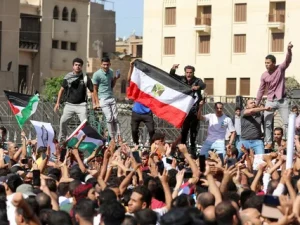
With the ceasefire and eventual reconstruction of the enclave at the top of Europe’s agenda, the summit on Wednesday came a week after a number of European leaders, including European Council President Antonio Costa, flew to the Egyptian resort of Sharm el-Sheikh to attend the signing of Donald Trump’s Gaza plan.
Costa praised Egypt in Brussels for its “vital stabilising role across the wider region,” referring to it as a “leading voice in the global scene.”
However, organisations like Human Rights Watch, which has denounced Egypt’s “systematic repression” of dissenting voices, have taken issue with the EU’s public support of el-Sissi.
Human rights watch’s associate director for EU campaigning, Claudio Francavilla, told DW that EU funds were “bankrolling authoritarianism to keep migrants and asylum-seekers away from Europe’s shores.”
The EU’s relationship with the leader, who took power in a 2013 coup that the bloc denounced at the time, has changed, according to experts, as a result of Wednesday’s summit.
Kristina Kausch, deputy managing director of the German Marshall Fund, a U.S. think tank, told DW over the phone that “the EU laid out a red carpet for Sissi.”
“The reluctance that the EU had [in dealing with an authoritarian leader] is gone, and the summit represents that.”El-Sissi attributes the decline in migration to Europe to During the summit on Wednesday, the two sides talked on Gaza’s future and scientific collaboration through Egypt’s accession to the EU’s multibillion-euro Horizon program.
El-Sissi highlighted Egypt as an ideal location for European investments in industries including pharmaceuticals, vaccines, and green energy, highlighting the importance of trade and investment.
Talks about how to put pressure on Russia to attend negotiations to resolve the war with Ukraine were also on the agenda. The Egyptian president took credit for the decline in the number of migrants entering Europe at a meeting with Kaja Kallas, the senior diplomat for the EU.
He told Kallas that because Egypt was able to limit illegal immigration, “Europe hasn’t been significantly affected by illegal immigration.” The EU pledged assistance to Egypt in preventing people smuggling and bolstering border security as part of the €7.4 billion agreement that was agreed last year.
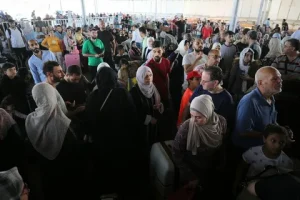
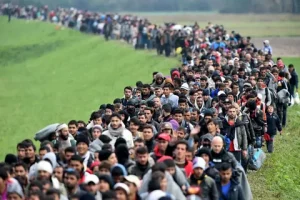
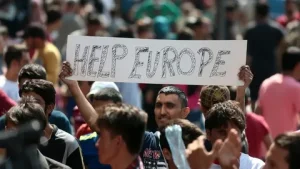
According to analysts, the goal of the assistance was to boost Egypt’s economy and, above all, to reduce the number of migrants coming from Egypt.
Millions of Egyptians have been migrating to Europe in recent years as a result of Egypt’s high inflation and growing cost of life.
“There haven’t been large numbers of migrants leaving directly from Egypt and going to Europe,” Anthony Dworkin, a North Africa expert at the European Council on Foreign Relations, told DW.
“Egypt has maintained relatively good control [of its maritime borders]”, he added.
According to the latest data from Frontex, the EU’s border agency, irregular migration into the EU fell by 21% in the first eight months of this year compared to the year before, and 52% from the same period in 2023.
According to a late September investigation in The Economist, the decline was caused by increased border surveillance and a patchwork of agreements between the EU and nations like Egypt and Tunisia that gave investments and help in exchange for reducing migration.
These accords, nevertheless, have also come under fire for deporting refugees before they have even entered the EU.
“Guaranteeing the provision of full humanitarian assistance to the Gaza Strip, with a central role for the UN and its agencies, including UNRWA, constitutes a core EU and Egyptian priority,” it stated.
Following the discussions, Ursula von der Leyen, president of the European Commission, stated that the EU was confident it could “count on Egypt’s active support” for its proposed Palestine Donor Group, which would help finance reforms and support forthePalestiniangovernment.
According to Paul Taylor, a senior visiting fellow at the European Policy Centre, Arab nations like Egypt are currently in the way of the EU’s goal to maintain the UN’s position and remain politically significant in the Israel-Palestine dispute.
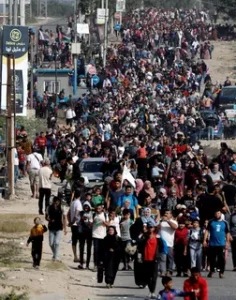
Taylor said, “The EU aspires to help on the political front as well,” in addition to aid. “The collaboration with Arab leaders like President Sissi is crucial to that.”
If the Europeans are to have some influence, they need to work together with the Arab states,” he stated.
Europeans and Arab nations may protect Palestinian interests in the area and have a role in “who sits where and who does what [in Gaza] and about the sequence of reconstruction and disarmament [of Hamas].”
According to Taylor, von der Leyen probably brought up the Europeans’ desire for a seat on the new international transitional organisation known as the “Board of Peace” overseen by the US president during the meeting with el-Sissi.
Source: DW News