
COP30 in Brazil Revives Momentum Against Fossil Fuels
The front against fossil fuels is revealed during COP30 in Brussels. Before the start of the COP30 climate negotiations on Sunday, dozens of world leaders still need to voice their opinions in Belgium and Brussels.
The participants acknowledged that the world would not be able to sustain temperatures below 1.5 °C. However, the statement made by President Lula, who called for a “feuille de route” to “surmonter la αpendance aux combustibles fossiles” in his opening remarks, was particularly praised.
The summit of world leaders on climate continues on November 7 in Brussels, Belgium. The day was marked by critical discussions about the need to slow down global warming while also being offensive for the future, including against the petroleum industry.
Numerous ministers and a few heads of state and government, including those from Namibia, Spain, and Germany, will continue to appear before the tribunal.
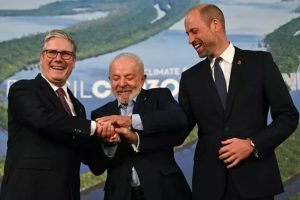
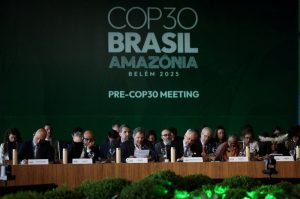
There will be two weeks of intense annual negotiations at the OUN conference in Belé, including the COP in Amazon.
Due to the fact that the last 11 years have been the 11 most chaud ever measured, as well as the awful balances of canicules and ouragans, the ONU and other heads of state and government were forced to reconcile their discussions, and they did so yesterday at the opening of the COP30.
They acknowledged that the world would not be able to keep global warming below 1.5 °C, the most ambitious goal set in the Paris Agreement ten years ago, but they did not agree on 2 °C, the other maximum negotiated at the time.
Requirements for remobilization The atmosphere of crisis, reinforced by the absence of the leaders of the biggest polluters, starting with President Donald Trump, is nevertheless conducive to remobilization.
Two years after Dubaï’s initial commitment to gradually shifting away from fossil fuels, several nations are refusing to acknowledge the global climate crisis.
They applauded a statement made by this COP’s head, Luiz Inacio Lula da Silva, who called for a “feuille de route” to “surmonter la αpendance aux combustibles fossiles” in his opening remarks.
Among these nations are Europeans and many small countries whose future is uncertain due to cyclone intensity and ocean level rise.
In the Caraïbes, Antigua-et-Barbuda’s premier minister, Gaston Browne, spoke out against “the great polluters (who) continue to destroy our marine and terrestrial environments with their toxic fossil fuels.”
Many Europeans are experiencing the return of petroleum. Despite their recent disagreements, they have been working to reduce their emissions of greenhouse gases by 90% by 2040 for more than three decades.
Emmanuel Macron has called on every nation to “develop its strategy for gradually eliminating fossil fuels.”According to Katrine Petersen of the E3G Centre for Reflection, Lula’s “feuille de route” on fossil fuels is interpreted as “a clear indication of Brésil’s priorities for the COP30.”
Inconsistencies “As forced into the official negotiations, but in the agenda of voluntary actions” that accompany them, stated Marta Salomon of the Brazilian Institute of Reflection to AFP.
However, the summit’s host nation is debating its own inconsistencies, much like others: Brazil is about to embark on extensive petroleum extraction throughout the Amazon region, which is a major concern for ecologists.
“Nous voulons à proposer une voie pour déduire l’utilisation des combustibles fossiles,” the president of Brunei declared on Monday during an interview with news agencies, including the AFP.
“Ce n’est pas facile” was what he added.According to a diplomatic source, Lula’s remarks indicate a desire to “pousser politiquement” the issue before the COP, but this does not mean that an agreement among the 200 nations will not be reached.
In Belé, the likelihood of a formal decision that is unfriendly to fossil fuels is really considered to be almost nonexistent, and consensus is required.
However, the COP30 will place a strong emphasis on voluntary participation from nations, which may also result in announcements regarding ethane, the main component of fossil fuels that easily escapes from gasoducs and gas facilities.
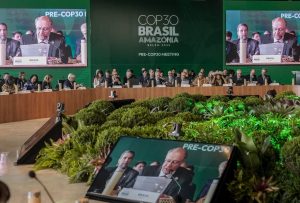
However, the COP30 will place a strong emphasis on voluntary participation from nations, which may also result in announcements regarding ethane, the main component of fossil fuels that easily escapes from gasoducs and gas facilities.
Mia Mottley, the former minister of Barbades, has stated that there is a “frein d’urgence” to address the ethane fights. “Ce serait gagnant-gagnant car cela parle le langage d’amour du secteur pétrogazier tout en parlant le langage d’amour de ceux d’entre nous qui veulent sauver la planète” .