

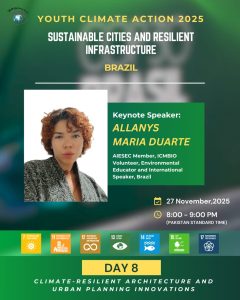
Climate Resilient Architecture and Urban Planning Innovations by Alanys Maria
Climate change is reshaping the way cities grow, how communities interact with their environment, and how leaders rethink development.
In her insightful session, she explored the transformative power of climate resilient architecture and community driven urban planning, reminding us that sustainable cities can only emerge when people and nature are placed at the center of development.
Opening Thought: Moving Forward Together
The session began with an African proverb:
“If you want to go far, go together.”
This message framed the entire discussion underscoring that climate resilience is a shared responsibility. Only through collective action can communities build environments that protect biodiversity, ensure safety, and promote long-term sustainability.
Brazil’s Reality: Bureaucracy Without Solutions
She reflected on Brazil’s overwhelming bureaucracy systems that often claim to be legal, moral, and efficient but fail to address real climate and social issues. She emphasized that despite frameworks and regulations, many communities still lack functional, climate resilient solutions on the ground. This gap highlights the urgent need for practical and people centered planning.
Transforming Urban Spaces: From Dumps to Parks
One of the most inspiring stories shared was the transformation of a rubbish dump into a vibrant public park. This project demonstrated the immense potential of reimagining degraded spaces. The redesigned environment served multiple purposes:
Supporting biodiversity and restoring natural habitats
Enhancing mental health and community well being
Introducing agro forestry to heal soil, grow food, and rebalance ecosystems
Such success stories show how even the most neglected areas can become ecological assets.
Community Centered Urban Planning
She emphasized that climate resilient planning must start with people not only with infrastructure. Her approach includes deep community engagement, especially with mothers and families. Key priorities identified through this process include:
Safe spaces for children
Outdoor areas for elders
Accessible green public spaces
By working with communities directly, planners can design cities that are inclusive, safe, and naturally resilient.
Why Women Are at the Center of Resilience
Citing data from the Ibeji Report, she noted that half of families are led by women, positioning them as crucial decision makers. Women manage households, daily resources, and immediate climate impacts making their empowerment essential for community resilience. Her work focuses on giving women space, support, and leadership opportunities within urban development processes.
Rethinking Resilient Infrastructure
Climate resilience is not the sole responsibility of governments or large institutions. It is interconnected across society, involving:
Youth
Academia
Think tanks
Grassroots organizations
Local communities
Sustainable cities require collaboration across these diverse stakeholders, ensuring that resilience is built from the ground up.
Solarization and Green Offices
She further explained the importance of solarization and green building design, highlighting how they contribute to better cities:
Reduced carbon emissions
Lower operational costs
Improved indoor environmental quality
Enhanced climate adaptation capacity
Green offices and energy efficient buildings lead the way toward sustainable urban transformation.
Strategies to Promote Climate Resilient Architecture
To advance sustainable urban development, the speaker outlined several strategies:
Conducting awareness campaigns on sustainable living
Encouraging community driven design initiatives
Expanding green infrastructure like parks, green roofs, and permeable pavements
Integrating nature based solutions into planning
Supporting women and youth as local climate leaders
These strategies help bridge the gap between policy ideals and real world change.
The Role of Youth in Sustainable Cities
Youth representatives have a vital role in shaping climate resilient futures. Their responsibilities include:
Advocating for sustainable cities in schools, universities, and community spaces
Raising awareness on climate impacts, urban pollution, waste management, and renewable energy
Motivating peers to participate in environmental actions
Collaborating with councils, NGOs, and local leaders
Serving as ambassadors for green and resilient infrastructure
Young people bring innovation, energy, and bold ideas that can reshape urban futures.
Why Sustainable Cities Are a Global Necessity
Climate resilient cities are not optional they are necessary to:
Mitigate floods, heatwaves, and pollution
Protect biodiversity and ecosystems
Ensure public health, safety, and equity
Foster economic growth without harming the environment
Secure a livable planet for future generations
The future of urban development depends on balancing growth with ecological responsibility.

Conclusion: Building the Future Together
She concluded with a powerful reminder: climate resilience thrives through shared responsibility. When communities, policymakers, and institutions work together and when women and youth lead meaningful change cities transform into spaces that are inclusive, sustainable, and prepared for an evolving climate.
The path forward requires not just building stronger infrastructure but cultivating stronger communities. True resilience begins with people, rooted in nature based solutions and collaborative action.