
Carney Rejects Trump Claims, Says Canada Not Pursuing China Free Trade Deal
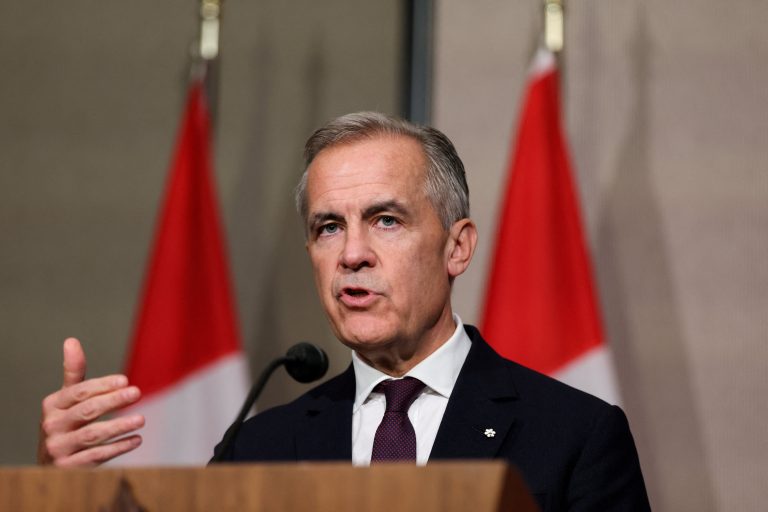
Canadian Prime Minister Mark Carney has firmly rejected claims that Canada is moving toward a free trade agreement with China, responding to US President Donald Trump’s threat to impose a 100% tariff on Canadian imports.
Speaking on Sunday, Carney clarified that a recent agreement with Beijing does not constitute a free trade deal, but instead involves limited tariff reductions aimed at resolving trade disputes that emerged over the past two years.
“We have no intention of doing that with China or any other non-market economy,” Carney said, referring to a full-scale trade agreement.

Trump Threatens 100% Tariff on Canadian Goods
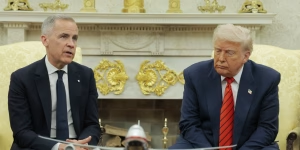
Trump had warned that the United States would impose a 100% tariff on goods imported from Canada if Ottawa proceeded with a trade deal with Beijing. In a post on Truth Social, the US president accused China of “successfully and completely taking over” Canada, adding a characteristically sharp remark about ice hockey.
Carney dismissed the claims, stating that the agreement in question merely reverses retaliatory tariffs imposed by both countries during a recent trade dispute.
USMCA Rules Limit Canada’s Trade Options
The Canadian prime minister emphasized that under the US-Mexico-Canada Agreement (USMCA), signatories are required to notify partners before entering into trade agreements with non-market economies.
Canada, Carney said, remains fully committed to those obligations.
“What we have done with China is to rectify some issues that developed in the last couple of years,” he explained.
Background: Tariffs and Retaliation Between Canada and China
In 2024, Canada aligned with the United States by imposing:
-
A 100% tariff on Chinese electric vehicles
China responded with:
-
100% import taxes on Canadian canola oil and meal
-
25% tariffs on pork and seafood
During a recent visit to China, Carney agreed to roll back Canada’s 100% tariff on Chinese electric vehicles in exchange for reduced Chinese tariffs on Canadian agricultural exports.
Limits Placed on Chinese EV Imports
As part of the revised arrangement, Canada introduced caps on Chinese electric vehicle imports:
-
49,000 vehicles annually at a 6.1% tariff initially
-
Rising to around 70,000 vehicles over five years
Carney noted that prior to 2024, there was no cap on Chinese EV imports. Even under the new framework, capped imports would represent roughly 3% of Canada’s annual vehicle sales, which total about 1.8 million units.
In return, China is expected to begin investing in Canada’s auto industry within three years.
Conclusion
Carney’s response underscores Canada’s effort to balance economic pragmatism with geopolitical realities. While seeking to stabilize trade relations with China, Ottawa is making clear that it remains aligned with USMCA commitments and is not pursuing a broader free trade agreement with Beijing.
As trade tensions and election-year rhetoric intensify in the United States, Canada’s trade policy is once again caught at the intersection of Washington–Beijing rivalry.