
Introduction: Canada France Consulates in Greenland Amid US Geopolitical Tensions
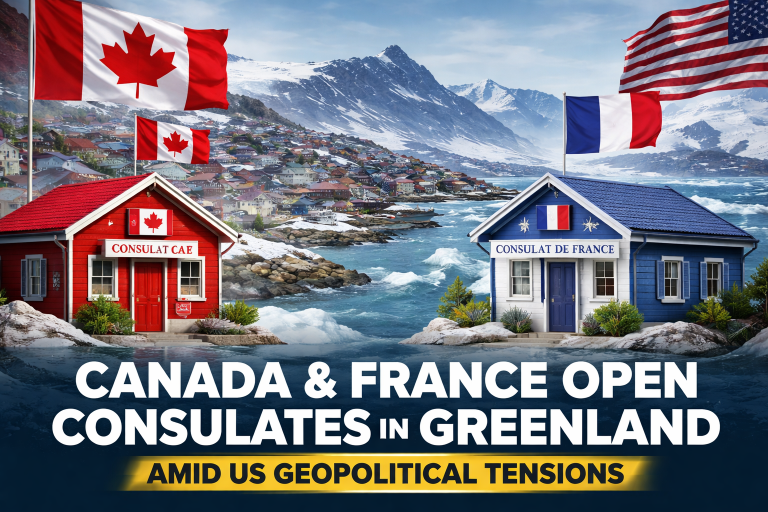
Canada and France have announced the opening of new diplomatic consulates in Greenland at a time when the Arctic island is becoming a major focus of global politics.
Greenland, a semi autonomous territory of Denmark, has drawn fresh attention due to renewed United States interest and growing strategic competition in the Arctic region.
The move by both countries reflects support for NATO ally Denmark and signals a wider effort to strengthen diplomatic presence as geopolitical pressure increases.
Diplomatic Expansion in Nuuk Strengthens Arctic Partnerships
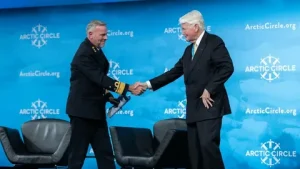
Canadian Foreign Minister Anita Anand travelled to Nuuk to formally open Canada’s new consulate, highlighting cooperation on climate change and Inuit rights.
She was joined by Canada’s Indigenous Governor General Mary Simon, reinforcing shared Arctic heritage and regional cooperation. At the same time, France appointed Jean Noel Poirier as consul general, making France the first European Union country to establish a consulate general in Greenland.
French officials stated that the mission will focus on strengthening cultural, scientific, economic, and political cooperation while maintaining close dialogue with Greenlandic authorities.
Rising US Interest and Strategic Importance of Greenland

The increased diplomatic activity comes as US President Donald Trump continues to stress the importance of Greenland for American national security.
He has argued that stronger US influence over the island is necessary because of its strategic location and rich natural resources. Although Trump recently softened earlier takeover rhetoric after discussions with NATO leadership and agreed to a working group with Denmark and Greenland, uncertainty remains due to the lack of public details.
This situation has encouraged allies to strengthen diplomatic ties and reinforce regional cooperation.
Read: Growing International Presence in the Arctic Region
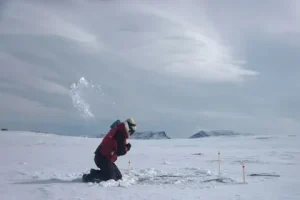
Greenland has become a hub of international diplomatic attention. Iceland opened a consulate in Nuuk in 2013, while the United States reopened its own consulate in 2020 after decades of absence.
Canada had already pledged to open its consulate in 2024, though harsh weather delayed the formal launch until now. These developments show how climate change, new shipping routes, and access to mineral resources are pushing countries to increase their involvement in Arctic affairs.
Analysis: Strategic Signaling and Support for Denmark

The opening of consulates by Canada and France goes beyond routine diplomacy. It sends a clear signal that NATO allies stand behind Denmark’s sovereignty and Greenland’s political autonomy.
The Arctic is emerging as a key arena for economic and military competition, and increased diplomatic presence helps maintain balance and stability.
Canada’s focus on indigenous rights and environmental cooperation highlights a people centered approach, while France’s emphasis on cultural and scientific ties reflects a strategy built on soft influence and long term partnerships.
Recommendations: Strengthening Dialogue and Sustainable Cooperation
Maintaining peace and stability in Greenland requires consistent diplomatic engagement and transparent communication among all stakeholders.
Nations involved in Arctic policy should prioritize dialogue with Greenlandic authorities and local communities to ensure that development projects respect local interests.
Greater cooperation in environmental protection, climate research, and sustainable resource management can help reduce tensions and build trust among competing powers.
Way Forward: Diplomacy or Rivalry in the Future Arctic
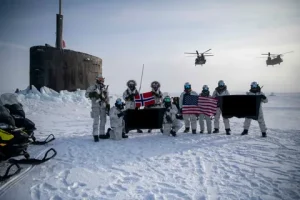
Greenland’s future will depend on whether global powers choose cooperation over confrontation. The opening of new consulates shows that diplomacy remains a key tool for balancing strategic interests with respect for sovereignty.
As climate change continues to reshape the Arctic, Greenland may either become a model for peaceful collaboration or a new center of geopolitical rivalry. The decisions made today by regional and global actors will play a crucial role in determining which path the Arctic region ultimately follows.