
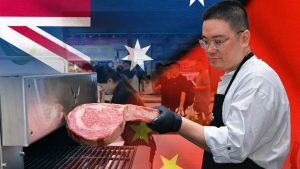
In an effort to safeguard a domestic cattle industry that is gradually recovering from overstock, China slapped a 55% tariff on imports that above quota levels, which Australian beef farmers described as “extremely disappointing.”
The entire import quota for Australia and other nations covered by its new “safeguard measures” is 2.7 million metric tons for 2026, according to China’s commerce ministry on Wednesday. This is nearly comparable to the record 2.87 million tons it imported altogether in 2024.
For Australia and its major supplier, Brazil, the new annual quota levels are set below import levels for the first eleven months of 2025.
The measure goes into effect on January 1st and lasts for three years, with an annual increase in the total allotment.
Anthony Albanese, the prime minister, downplayed the possible effects on the local cattle industry while stating that Australia was in contact with China on the move.
“Australia wasn’t singled out for this. China has adopted this broad stance, Albanese stated on Thursday. As usual, we are fighting for Australian business.
As the prime minister of Australia, I firmly believe that Australian beef is the greatest in the world. We are highly competitive in the global market, and our products are in high demand everywhere. We anticipate that this will remain the case. There has never been a stronger beef business in Australia than it is now.
David Littleproud, the head of the Nationals, called the tariff “devastating,” while Sussan Ley, the leader of the opposition, suggested Albanese use his connections with Xi Jinping, the president of China, to get a carve out.
However, the Australian Meat Industry Council (AMIC) called the measures “extremely disappointing” in response to the announcement, which infuriated cattle farmers.
Tim Ryan, the chief executive of AMIC, stated that the duties were not reasonable nor appropriate and did not represent the “long-standing, mutually beneficial trade relationship Australia has with China.”
According to Ryan, “this decision seems to reward other countries that have increased the volume of beef exported to the Chinese market in recent years.”
“During the duration of the measures’ enforcement, this decision will have a severe impact on trade flows to China, disrupt the long-standing relationships fostered under the China-Australia Free Trade Agreement, and restrict the ability for Chinese consumers to access safe and reliable Australian beef.”
In the first eleven months of this year, China’s imports of beef decreased by 0.3% to 2.59 million tons. According to Hongzhi Xu, senior analyst at Beijing Orient Agribusiness Consultants, the measures will cause a decrease in Chinese beef imports in 2026.
“When compared to nations like Brazil and Argentina, China’s beef-cattle farming is not competitive,” Xu stated. “Neither institutional reforms nor technological advancements will be able to reverse this in the near future.”
A farmer using a tractor to spread barley in a dusty field Australia wants to settle its trade issue with China directly before the WTO rules.
China bought 1.34 million tons of beef from Brazil, 594,567 tons from Argentina, 243,662 tons from Uruguay, 216,050 tons from Australia, 150,514 tons from New Zealand, and 138,112 tons from the United States in 2024.
According to Chinese customs data, Brazil sent 1.33 million tons of beef to China in the first 11 months of this year, significantly exceeding the quota levels established by Beijing’s new policies.
Additionally, Australian supplies to China have increased this year, gaining market share at the expense of US beef after Beijing permitted permits at hundreds of US meat plants to expire in March and after Donald Trump launched a tit-for-tat tariff battle.
Source: The Guardian