
AI and Youth: Shaping the Future of Climate Innovation Together
Introduction
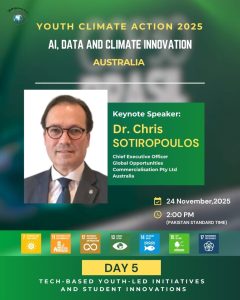
In an era where climate change is accelerating faster than ever before, Dr. Chris opened the session with a powerful message: artificial intelligence is no longer optional in shaping climate solutions—it is essential.
He highlighted how AI is transforming global responses by enabling faster predictions, deeper insights, and more efficient resource use. Most importantly, he emphasized that youth are not passive participants in this transformation.
Their adaptability, digital fluency, and deep community linkages position them as key drivers of climate innovation.
Who Leads Who? Rethinking Climate Leadership
A central question framed the discussion: Who should lead climate action—global institutions, technology, or local actors?
Dr. Chris described a dynamic, interconnected ecosystem:
AI and technology systems that generate data-driven insights.
Global institutions such as the UN, COP, ASEAN, and BRICS, which set the direction for global climate policies.
Local communities, whose everyday experiences reveal the true nature of climate change.
Traders, financiers, and private sector actors, who shape investment flows and economic priorities.
He stressed that while global bodies provide strategic guidance, local communities must define what is practical and contextually effective, because they directly face climate impacts.
Who Knows Best? Local Knowledge Leads the Way
One of the session’s strongest messages was that local communities have the most accurate and immediate understanding of environmental shifts. Their observations often detect changes long before formal datasets capture them. Examples include:
Shifting patterns in bird migration
Reduced fish populations
Changes in crop behaviour, soil moisture, or plant coloration
Sudden disease outbreaks in livestock
According to Dr. Chris, these lived experiences offer critical real-time insights. When integrated with AI models, they significantly improve the accuracy and relevance of climate solutions.
What AI Can Do for Climate Action
Dr. Chris outlined four major domains where AI is reshaping climate work:
Energy Optimization
AI enhances energy efficiency by analyzing consumption patterns, enabling smarter grids, and reducing unnecessary usage across industries.
Emissions Monitoring
Through satellite imagery, sensor networks, and automated reporting tools, AI can track greenhouse gases with unprecedented accuracy and guide targeted reduction strategies.
Climate Modeling and Prediction
By processing vast datasets, AI improves predictions for storms, heatwaves, floods, and droughts—allowing communities to prepare earlier and more effectively.
Resource Management
From agriculture to biodiversity conservation, AI supports sustainable decision-making by forecasting irrigation needs, tracking deforestation, and planning resource allocation.
AI, when paired with local insights, becomes a powerful tool for community-centered climate innovation.
Building an AI–Climate Ecosystem: Youth at the Center
Dr. Chris encouraged youth to engage directly with AI developers, climate-tech startups, and data providers. Youth hold unique strengths:
Deep familiarity with local environments
Access to communities and on-the-ground realities
Ability to observe and report real-time environmental changes
He urged young people to collect local observations—such as fish population shifts, unusual weather events, or crop pattern disruptions—as these help AI tools become more context-aware and effective.
Partnerships with AI providers should be continuous, involving feedback loops, data sharing, and collaborative tool design.
Clear Action Steps for Youth
To establish their leadership in climate innovation, Dr. Chris shared practical steps:
Develop a Clear Problem Statement rooted in observed local needs.
Form a Multi-skilled Team combining tech, environmental science, communications, and community outreach expertise.
Approach National and Global Organizations willing to support youth-led climate initiatives.
Prepare Strong Proposals with solid data, clear goals, and community alignment.
Build Trust with Community Leaders early on to ensure cultural alignment and long-term cooperation.
Consistent communication, thorough documentation, and regular follow-ups strengthen credibility and ensure sustainable progress.
Strategic Partnerships to Accelerate Impact
Dr. Chris encouraged youth to leverage diverse partnerships, including:
Tech philanthropists, offering tools or grants
Computer access programs, supporting digital inclusion
Scientific and environmental institutions, providing technical expertise
Government bodies, offering visibility and long-term stability
Local NGOs and global platforms, expanding outreach and collaboration
Strong alliances amplify growth, impact, and sustainability of youth-led projects.
Using Networks to Scale Solutions
Youth networks, climate forums, and innovation platforms offer mentorship, training, funding opportunities, and collaborative spaces. Dr. Chris encouraged young climate leaders to actively participate in these networks to learn, share, and amplify their work.
These platforms connect young innovators with global best practices, experts, and successful models that can be adapted to local contexts.
Conclusion
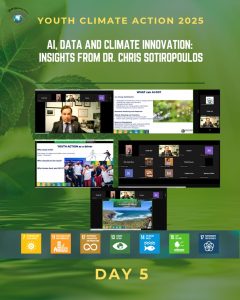
Dr. Chris closed the session with an inspiring message: the future of climate innovation belongs to youth. By combining the power of AI with the wisdom of local communities, young people can reshape global climate action. He urged youth to be bold, proactive, and confident—reminding them that numerous institutions, experts, and networks stand ready to support their journey.