
Erdogan Demands Kurdish Forces Disarm as Tensions Rise in Northern Syria
Turkey’s President Recep Tayyip Erdoğan has escalated pressure in northern Syria as Erdogan demands Kurdish disarm immediately, warning that armed Kurdish groups near Turkey’s border will not be tolerated. The statement, reported by Reuters, comes amid shifting alliances, a fragile ceasefire, and renewed regional tension over Syria’s future.
The statement comes at a sensitive moment, as power dynamics in Syria continue to shift and regional actors reassess their military and political positions.
Erdogan Demands Kurdish Forces Disarm Without Delay
Speaking to members of his ruling AK Party, Erdoğan said the issue must be resolved permanently and without further bloodshed. However, he made it clear that armed Kurdish groups would not be allowed to remain active near Turkey’s frontier.
Erdogan demands Kurdish forces disarm as part of what Ankara describes as a long-standing national security concern. Turkish officials argue that any armed presence linked to Kurdish militias near the border poses a direct threat to the country.
 Why Turkey Opposes Kurdish Armed Groups in Syria
At the center of Turkey’s position is the Syrian Democratic Forces (SDF), a Kurdish-led alliance controlling large parts of northeastern Syria. Ankara views the SDF and its main faction, the YPG, as closely linked to the Kurdistan Workers’ Party (PKK).
Turkey has fought the PKK for decades and officially labels it a terrorist organization. From Ankara’s perspective, allowing related armed groups to operate freely in Syria risks cross-border attacks, weapons smuggling, and long-term instability inside Turkey.
Ceasefire Developments and Changing Power on the Ground
Erdoğan’s remarks follow a recent ceasefire agreement between Syrian government forces and the SDF. The truce aims to reduce fighting in northeastern Syria after Syrian government advances backed by regional allies.
While Erdoğan welcomed the ceasefire cautiously, he stressed that a temporary pause in fighting is not enough. He said lasting peace requires armed Kurdish groups to fully disband, not simply halt operations.
Turkey has carried out multiple cross-border operations in Syria in recent years to push Kurdish fighters away from its border. The current situation suggests Ankara believes it has a strategic opening to secure long-term gains.
The United States and the SDF Alliance
For years, the United States supported the SDF as a key partner in the fight against ISIS. However, regional realities are shifting as Syria’s government seeks to restore control over its territory.
Erdoğan said Turkey remains committed to fighting ISIS but insists that counterterrorism efforts cannot justify the presence of armed groups it considers hostile. On the same day as his remarks, Erdoğan held talks with U.S. President Donald Trump, underlining the importance of coordination between Ankara and Washington on Syria.
Domestic Signals and Regional Impact
Erdogan demands Kurdish forces disarm not only as a regional message, but also as a domestic one. Turkey continues to manage internal Kurdish tensions while trying to prevent renewed armed conflict within its borders.
By framing his demand as a path to stability, Erdoğan presented his stance as preventive rather than aggressive. Still, the demand raises difficult regional questions:
Will Kurdish forces agree to disarm or integrate into Syrian state institutions?
Can Damascus guarantee security and political rights for Kurdish communities?
How will global powers balance alliances with security concerns?
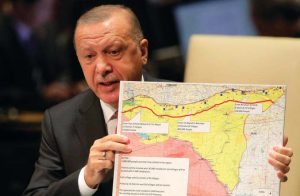
A Defining Moment for Northern Syria
Erdoğan’s call for Kurdish forces in Syria to disband marks a critical moment in the country’s post-war landscape. It reflects Turkey’s determination to shape the future of northern Syria and eliminate what it sees as direct security threats.
As diplomatic talks continue and ceasefire efforts remain fragile, the fate of Kurdish-controlled areas is far from settled. Whether this demand leads to negotiation or renewed confrontation will play a major role in shaping regional stability in the months ahead.