
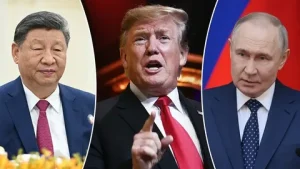
Tripolar World: How Putin, Trump, and Xi Are Reshaping Global Power
A World Colliding, Not Drifting
The world is no longer drifting-it is colliding. Putin’s war in Ukraine has shattered Europe’s post-Cold War assumptions. Xi’s pressure on Taiwan is redefining the meaning of deterrence in Asia.
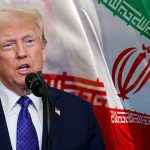
Trump’s return to power, from Venezuela to NATO, signals an America increasingly willing to act outside the boundaries of the international order it once built.
These are not isolated crisis. Together, they mark the arrival of tripolar world, shaped less by institutions than by the ambitions of three men.
Greenland and the Arctic Move to Center Stage
The renewed attention on Greenland further illustrates this shift. Once considered a geopolitical afterthought, the Arctic has become a strategic frontier as melting ice opens because of climate change opens new trade routes and access to the resources.
Trump’s administration interest in Greenland, often dismissed as impulsive, reflected a deeper logic of territorial leverage.
Meanwhile, Moscow has expanded its Arctic military footprint, while China brands itself a near Arctic state, seeking influence through investment and infrastructure. In a tripolar world, even ice-covered land has become a currency of power.
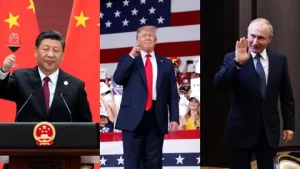
Greenland as a Strategic Prize
Moreover, Greenland, long considered a remote Arctic outpost, has quietly emerged as a strategic prize in the tripolar world.
Beyond its melting ice and new shipping routes for trade, the island holds untapped REE (rare earth elements) reserves, essential for modern technology, advanced weaponry, renewable energy, and even in EV industry.
In this context, for Xi, control over global REE supply chains is critical to sustaining China’s economic and military power. For Putin, access to alternative sources reduces dependence on foreign markets and sanctions vulnerabilities.
For Trump, Greenland is not just a territory, but leverage in a resource-driven geopolitical chessboard.
In this context, REEs reveal the deeper logic of tripolar world: global influence is economies, armies, and the technological edge of the twenty-first century, making even ice-covered lands central to strategic calculations.
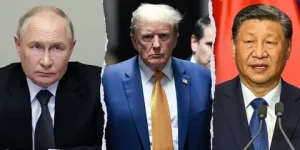
REEs Under the Ice and the Battle for the Future
The future of our cars and our world may be buried under ice. Greenland, long a quiet Arctic frontier, is abruptly at the focal point of a global tug-of-war. Beneath its glaciers lie rare earth elements (REE).
The hidden materials that power everything from electric vehicle batteries to wind turbines and advanced military technology. In a world dominated by Putin, Trump, and Xi, even ice-covered lands have become pieces on geopolitical chessboard.
For Xi, these resources are vital to keeping China ahead in EV production and tech innovation. For Putin, they are a hedge against sanctions and a way to secure strategic independence.
And for the United States of America, Greenland is not just territory it is a chance to ensure that the next generation of cars, grids, and rockets is made at home, not dictated by others.
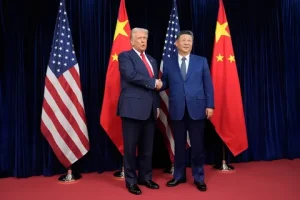
EVs, Tech Giants, and the New Resource Race
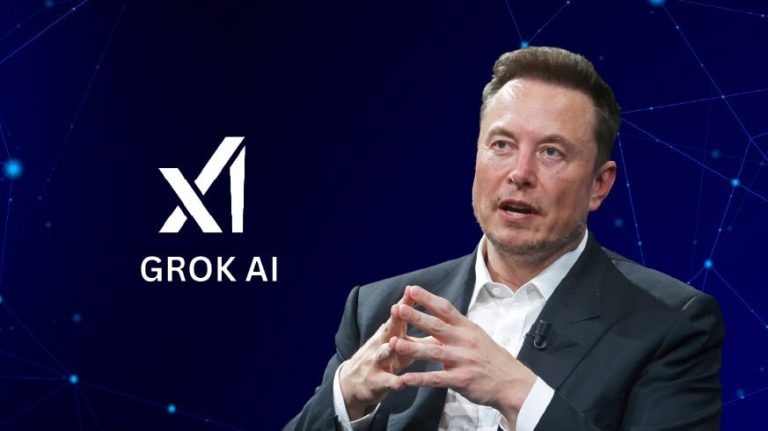
But this is not just about nations. Bigwigs like Elon Musk are reshaping the story, turning EVs from a niche innovation into a global obsession. Every Tesla on the road is a reminder that rare materials, once obscure and ignored, now carry the weight of national strategy.
Musk’s ambitions have made the demand for REEs not just an economic issue, but a geopolitical one, connecting the frozen landscapes of Greenland to the streets of every city racing toward an electric future.
In this tripolar world, power is no longer measured only by armies or alliances it is measured by who controls the materials and technology that define the next era.
Greenland, EVs, and visionaries like Musk show that the future is not just coming it is being built, one battery, one innovation, and one geopolitical move at a time.
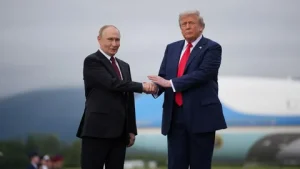
Power, Rules, and a Changing World
The world we thought we knew ordered, predictable, bound by rules is slipping from our grasp. Putin’s war in Ukraine, Xi’s pressure on Taiwan, and Trump’s America, ready to bend the old rules, remind us that global power is now personal, messy, and unpredictable.
But the story doesn’t end with borders and armies. It stretches to the frozen landscapes of Greenland, where melting glaciers reveal rare earth elements that will shape the technologies of the future.
The hidden minerals semiconductors, EVs, renewable energy, and advanced military systems. Abruptly, what was once a remote Arctic outpost has become a silent focal point in the battle for influence. And it’s not just governments writing this story.
Entrepreneurs like Musk are reshaping it too. Every Tesla on the road, every battery powering a city, every wind turbine spinning in a distant field, is a reminder that technology can be as powerful as a fleet of tanks.
Musk’s vision has turned consumer demand into a geopolitical lever, connecting ice-covered Greenland to the streets of Shanghai, to boardrooms in Silicon Valley.
The age of power is no longer only about armies, treaties, or alliances it is also about who controls the materials and ideas that define our future.
A Lesson for the Next Generation
For the next generation of diplomats, entrepreneurs, and citizens, the lesson is clear: understanding today’s world requires more than maps or political papers.It demands seeing the connections between resources, and ambition.
Greenland’s ice, the rare minerals beneath it, and the rush toward an electric future are intertwined with the choice of leaders and innovations alike. Putin, Trump, Xi, they all are shaping the history, and it’s one we’re living in real time.
This Article is written by M Ahmad Azhar is a student of Public Policy at the National Defence University in Islamabad. He studies global power shifts, strategic competition, and emerging security trends. His work focuses on how political decisions, resources, and technology shape the world around us. As a geopolitical researcher, he looks at the links between leaders, regions, and the forces driving change in today’s international system.